


The Legal AI Landscape.
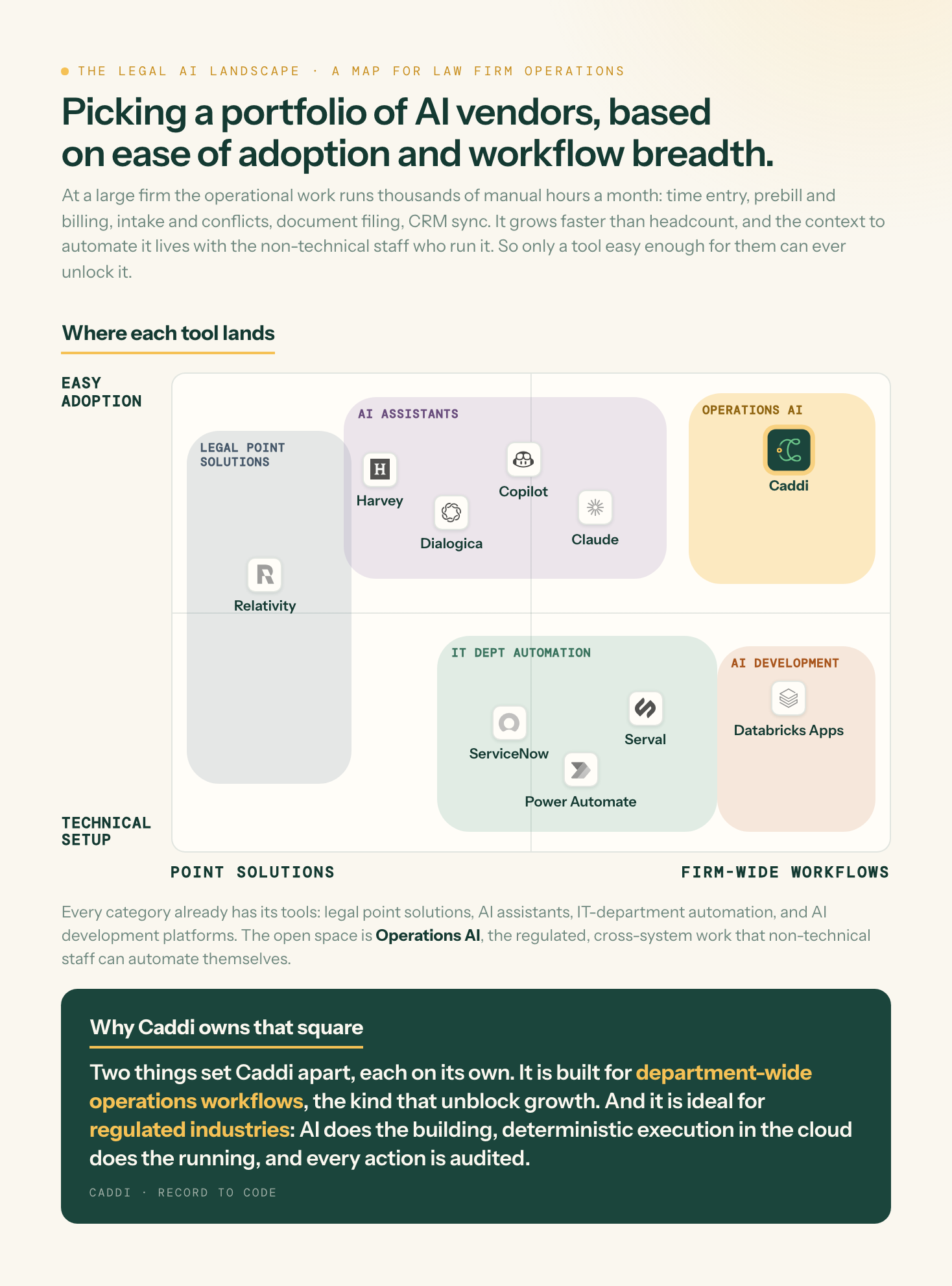
A thesis for your AI vendor portfolio strategy: the categories of legal AI and how they fit, mapped by ease of adoption against workflow breadth. Legal point solutions, AI assistants, IT-department automation, and AI development platforms each own a corner. Operations AI sits in the open square.
Build, buy, or teach the work.
The whole decision feels like a binary: buy a box or build it yourself. For operational work, both are bad. There is a third way most portfolios miss.
Turn it on, no build. But it is fixed to one slice and one system, it will never match your firm's process, and you end up with one box per problem.
Fits anything your developers build. But it is a standing engineering project, it stalls at the firm-specific 20%, and the people who own the work cannot build it themselves.
The person who owns the work demonstrates it. It fits your exact process and runs itself, with no vendor box and no dev project. The option most portfolios miss.
Which square does a use case belong in?
Run each workflow in your portfolio through this. Most of them already have a home. The operational ones cluster in the last row, and that is the cluster worth a tool.
For the architect.
Where Caddi sits in the stack, and how it behaves in a regulated firm.
Cloud, connected over OAuth and SSO. IT connects the firm's tools once in about five minutes; each user connects their own account.
Runs under each user's own credentials, inheriting the access IT already set. No new permission model, no new secrets to manage.
Works with Citrix and on-prem stacks exposed through an Azure API. Nothing installed on the desktop; the recorder lives in Chrome.
Middleware, not a data store. Caddi moves and processes information between your systems, it does not hold it.
OpenAI, Anthropic, and Google, swapped per task. OpenAI and Anthropic use zero-data-retention terms; Azure and Vertex retention is configuration-based. You can bring your own API keys.
Every API call and every action Caddi takes is logged across every system. Built for firms that get audited.
“Caddi focuses on applying AI to real business workflows in ways that are useful and effective.”
 Jordan PortnerCOO, Portner & Shure